Fire Weather 101
- firelinevalley
- May 11
- 6 min read

The 49er Fire
49er Fire — September 11, 1988
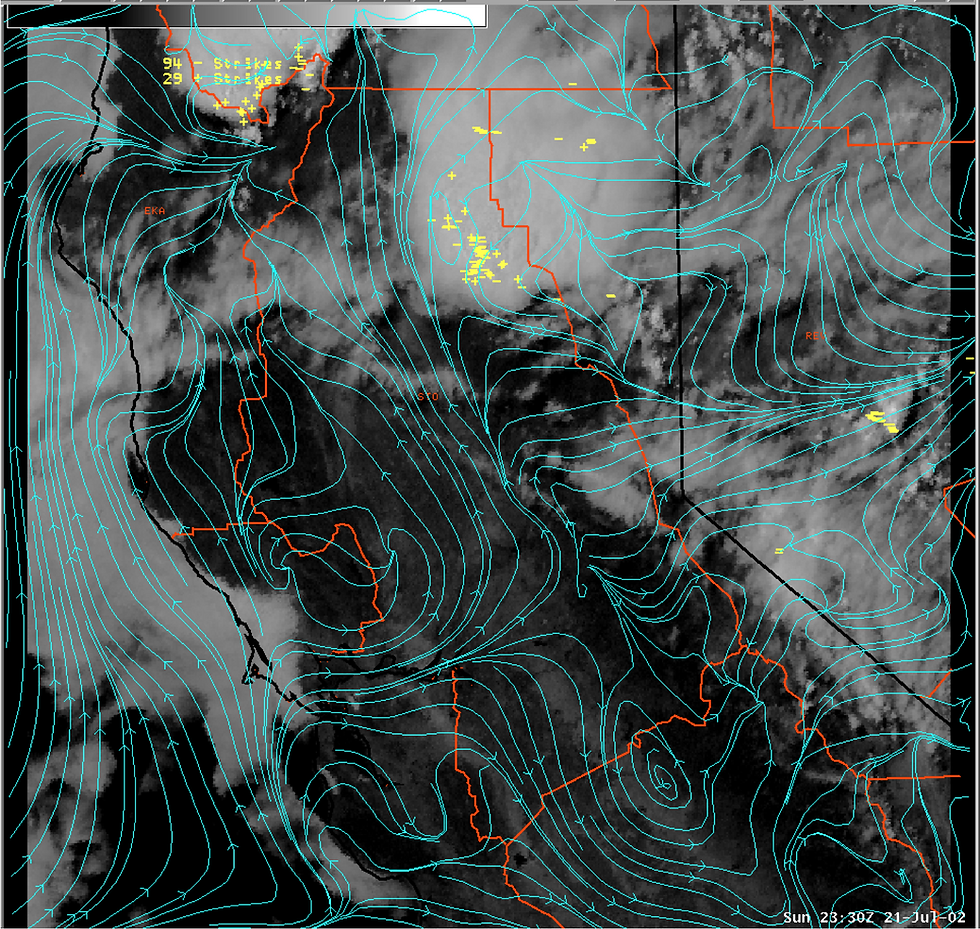
In the early morning hours of September 11th, 1988, a high-pressure system was streaming down from the Northwest into the Intermountain West, bumping into a low that had settled over the Southwest and a low moving through the central valley of California. In the space between them — in that ladder of air pressing down from the high toward the waiting low — lay the gold country of the Sierra Nevada, specifically Nevada and Yuba counties, and the once-mining towns of Grass Valley, Nevada City, North San Juan, and Smartsville, and a growing lake community called Lake Wildwood.

This maps tell the story plainly, the way rivers tell stories in every canyon they have ever cut.
The Pattern
A 1036-millibar high sat broad-shouldered over the northern Rockies, its isobars drawn tight as a clenched fist, while a ragged cluster of lows — 1004, 1009, 1010 — pooled across the Desert Southwest and into the Great Basin, with one fateful dry system sliding south of the central Sierra. The isobars running through the Sierra Nevada foothills were compressed and purposeful. The air had somewhere to go and nothing to stop it. Nevada City and Grass Valley lay precisely in the throat between them, in that narrow passage where the pressure gradient does its worst work.
The atmosphere does not improvise.
It had arranged the same furniture it always arranges when it means business: the high to the northeast, the low to the south, and the mountains between them that take whatever is moving and make it move faster.
As the pressure gradient began to take shape, the winds switched from their usual southwest flow to out of the northeast. Twigs, needles, and the overall duff began to lose their moisture as dry adiabatic air moved over and down the Sierra peaks the way trouble moves — quietly, and then all at once.
Late evening of the 10th and early morning of the 11th
On the ridge above the South Fork of the Yuba River, the pines began to sway in a direction they did not favor as the crickets fell silent, and the firefighters at the Columbia Hill CDF station — whether sleeping or merely attempting to sleep — kept one eye open, ready for the “quick call,” like sharks in the Pacific.
Weather stations began to show falling humidity levels, something that usually belonged to the heat of the day, not the dead of night. By three in the morning, power outages had begun to sprout across the area as lines and transformers lost their footing in the wind.
The lights of Nevada City flickered out here and there.
By approximately nine o'clock in the morning, Pacific time, the northeast winds were well established.
The fuels were primed.
The duff was powder.
The chamise and manzanita on the south-facing slopes held their moisture the way a wrung cloth holds water — which is to say they did not hold it at all.
All that was needed was the spark.
Birchville Road and Highway 49
Gary Wayne Parris, an unhoused man sheltering in the margins of those old mining hills, was burning strips of paper bags. The tempest that was already unfolding around him was not interested in his intentions. One strip caught the wind. Then another. The fire that would bear the name of a highway and a gold rush era went to work on the landscape with the focused purpose of something that had been waiting a long time. It went down the canyons and up the ridges and through the pines and dry grass with the indifference of weather, which is the worst kind of indifference. Burning past old mining claims, homesteads new and old, from northeast to southwest — starting from the high ridges near the old back-to-the-land hippie town of North San Juan and ending in the grassy flats west of Smartville, just shy of Beale Air Force Base. Thirty-three thousand acres later, the 49er Fire was stamped into history — the gold country burning again, though this time what was being refined was not ore.
Katabatic Winds
What those winds were, properly speaking, was katabatic — a word derived from the Greek katabatikos, meaning going downhill, which is precisely what they do and precisely what they were doing on the morning the 49er Fire was born.

Katabatic winds are a product of fundamental atmospheric physics. When a dense, cool or dry airmass accumulates over an elevated plateau or basin, its greater density relative to the air at lower elevations creates a pressure differential that gravity is only too willing to resolve. The air drains downslope through whatever topographic pathways are available to it — passes, canyons, river gorges — accelerating as those pathways narrow, in the same way that water accelerates through a constriction. The mountains do not create these winds. They shape them, concentrate them, and deliver them to the lowlands with a force that the open plateau never suggested was possible.
In California, the eastern escarpment of the Sierra Nevada presents one of the more consequential katabatic corridors in North America. The Great Basin, sitting at elevation behind that escarpment, serves as the source region — a reservoir of cool, dense, continental air that accumulates particularly during the fall months when the Pacific storm track retreates a bit northward and the inland plateau has begun to cool under clear skies. When a sufficient pressure gradient develops between that interior high and a relative low along the California coast, the Basin air does not wait. It finds the canyons — the Feather River Canyon, the American River Canyon, the Yuba — and it moves through them toward the valley with purpose and velocity.
Adiabatic Compression
The process is further intensified by adiabatic compression. As the air descends from the high elevation of the Basin toward the lower elevations of the western foothills, it compresses under increasing atmospheric pressure and warms at the dry adiabatic lapse rate of approximately 5.5 degrees Fahrenheit per thousand feet of descent. This warming is not a modest effect. Air that begins its journey as cool and relatively dry becomes, by the time it reaches the foothill communities of the Sierra Nevada, considerably warmer and dramatically drier. Relative humidity values that begin in the range of 30 to 40 percent in the source region can fall to single digits by the time that same airmass reaches the canyon mouths. Whatever moisture remains in the surface fuels — the grasses, the duff, the accumulated needle cast beneath the pines — is extracted with mechanical efficiency. The fuels do not gradually become receptive to ignition. They become primed for it.
The synoptic pattern that drives these events is well understood and, in the context of California fire weather, distressingly familiar. It is common in the sense that meteorologists recognize it immediately when it appears on the charts. It is common in the sense that it recurs with regularity across the fall season, year after year, in the Sierra Nevada foothills and in the coastal ranges to the south. It is not common in the sense that its consequences are ordinary.
Camp Fire
Thirty years later, on the morning of November 8, 2018, a forecaster studying the surface map over Paradise would have felt a cold recognition.
A 1039-millibar high had anchored itself over the Pacific Northwest and the northern Great Basin — the same geography, the same posture, the same intent. To the south, the familiar lows had returned to the Desert Southwest, patient and waiting at 1009 and 1010 millibars.
The isobars between them funneled northeasterly flow directly down the spine of the Sierra Nevada foothills, toward the ridge above the Feather River Canyon where Paradise sat among the ponderosa pines, unaware of what the map already knew.
The gradient was, if anything, sharper than it had been in 1988. The fuels were just as dry. The town in its path was larger. The fire ignited near Pulga and ran southwest — precisely along the gradient’s preferred path — and by noon, Paradise was gone.
The Camp Fire had been built from the same blueprint as the fire that burned through the foothills of Nevada County three decades earlier.

The atmosphere had not changed its mind. It had simply waited for another morning when the high was in the right place and the low was in the right place and the mountains were, as they have always been, in between.
The gold country knows this. The ridge above the Feather River knew it too, in the end. What those hills have always had in common — the pines, the dry grass, the canyon winds, the duff that cures like tobacco through a long dry summer — is that they are ready before anyone asks them to be. The spark is almost beside the point. The land is the point. The pattern is the point.
And the pattern always comes back.
49 Fire Images

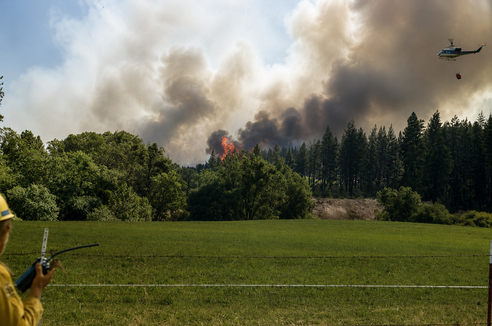


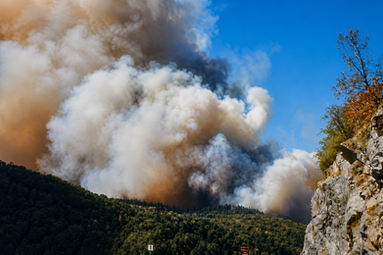

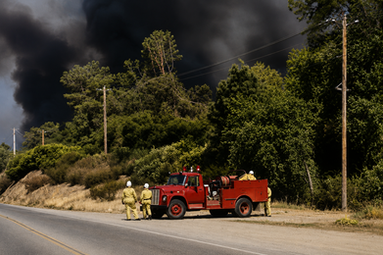

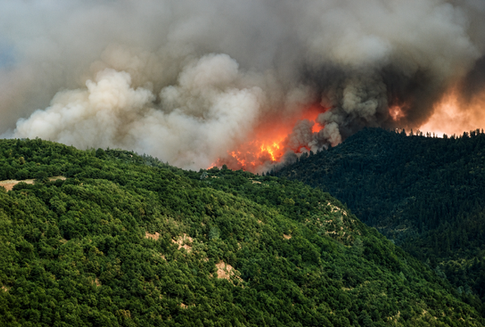

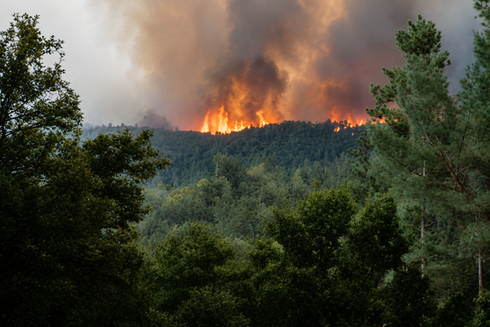

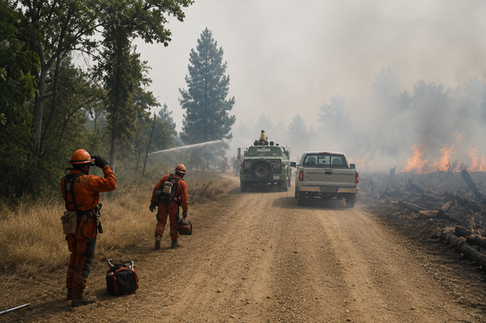






Circa photos Sean Griffis Cal Fire